Occasional Newsletter
July 2025
Essential Worker Housing Progress
Friends of Lorne have been advocating for the set up of an across-community group to be involved in reviewing housing options. Last week it happened. The Surf Coast Shire initiated the first of two workshops to consider housing problems and solutions. Eighteen people were invited across various organisations and sectors. Friends of Lorne took part along with the Committee for Lorne, the Op Shop, the Kindergarten and others. People who could not attend were followed up individually for their input by Alicia Hooper, the housing officer at the Council.
The first conversation at the workshop was, what does success look like? This was followed by an opportunity to express any concerns we have about the process. Once any frustration with past attempts was expressed, people engaged enthusiastically in trying to define the problem. Surely that is obvious, you’d think? A five-minute job? Well, not actually. A number of times we had to be drawn back to focusing on the problem (eg., keeping the school/ hospital/ hospitality etc sustainable) versus seeing the problem as perceived barriers to particular solutions only (eg., that private land is currently “locked away by planning controls”).
A strength of the workshop was the new voices brought to table. We heard firsthand, for example, that if you are an ambo you need to live within 8k of the depot.
What does Friends of Lorne want?
A sustainable Lorne, like everyone else. We have been putting first priority on solutions that don’t assume that all we must do is find land, clear trees and build new. Why? Because Lorne’s treed look is precious. Also, smaller, denser, concentrated clustered housing is not suited to young families or tradies (ie, who are often CFA/SES volunteers) with extra vehicles/equipment. We also want diversity of choice when it comes to housing options – ie., essential workers should be able to choose houses, house types and locations about town that suit them. We note that upwards of 60% of the houses in Lorne are currently not occupied full time. So, using those houses more seems smarter and faster than building new. Policy incentives for properties to join the long-term rental market could be investigated. Shared-equity investment schemes could make it easier for workers to buy homes. Crucially, we want solutions that grow and adjust with the problem. Let’s not just solve things for now and be back here in 5 years’ time, wondering how to do it again.
A couple of new Friends of Lorne members put up their hands to take part in the workshops. Thank you. We’re almost up to 150 members now and we hope it’s because we are doing things that matter.
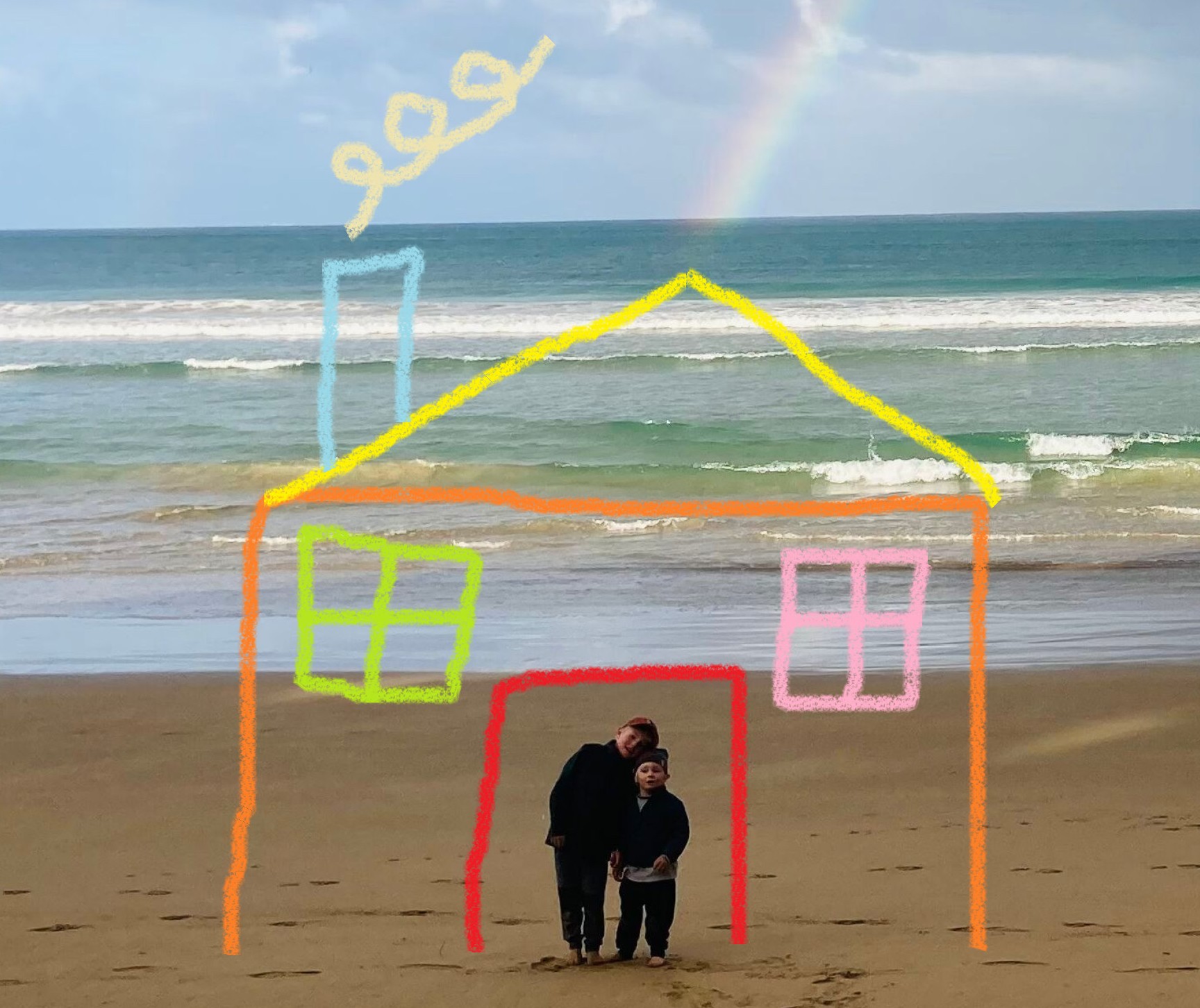 We love this image by Anna McIldowie
_____________
Pt Grey, what now? What next?
One of our members has approached our Committee asking that we lead a petition about Pt Grey. The committee is reluctant to lead another petition at this stage. The logic is that GORCAPA can be in no doubt about how the community feels, and so restating this (before they have had a chance to respond to recent feedback) seems wasted effort. Instead, we are investigating some precedents for solutions.
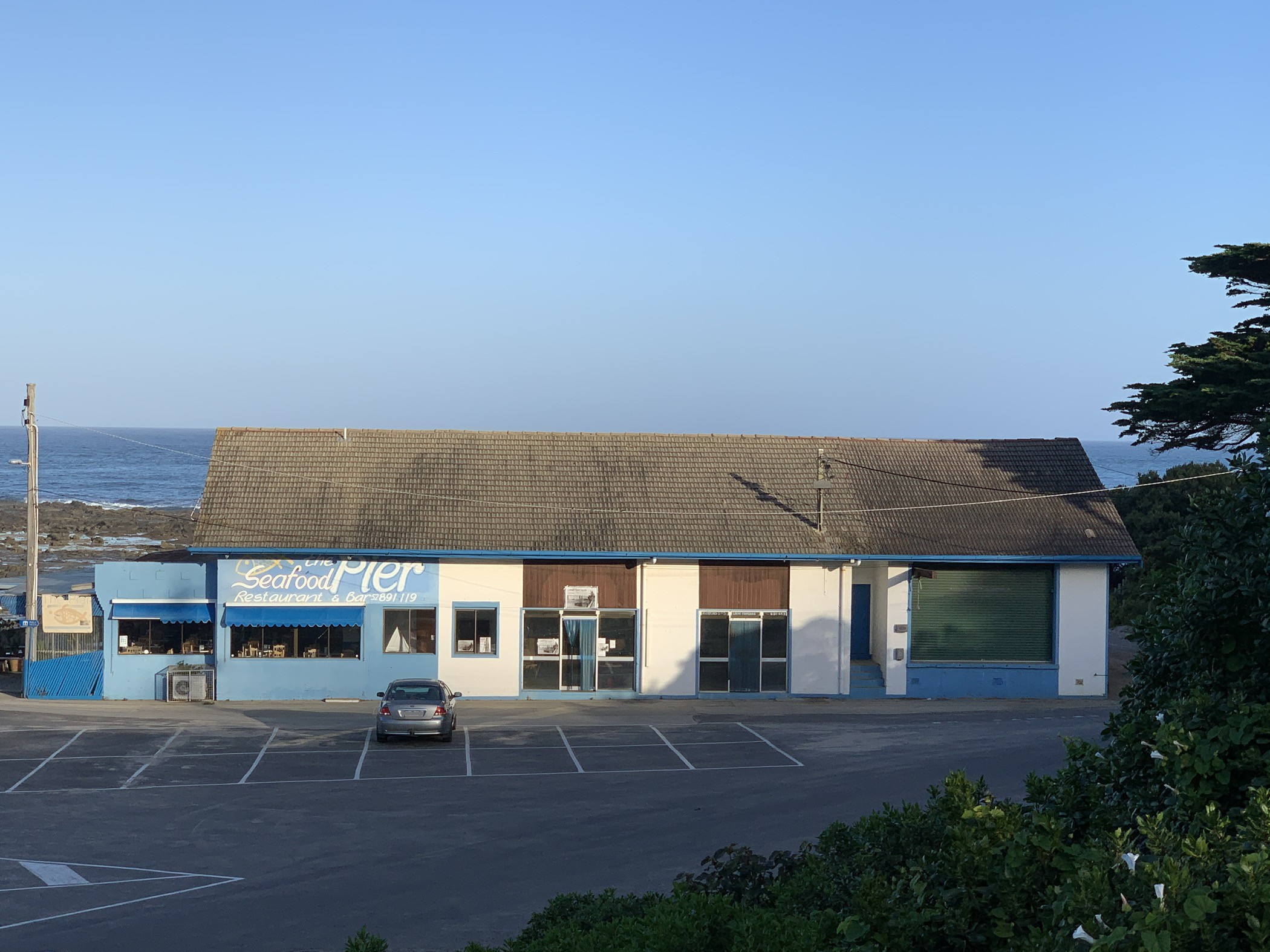
We are searching the VCAT case law reports to better understand how the Marine and Coast Act (which governs the site) has been interpreted and tested in the past. We also have reached out to the Melbourne Maritime Heritage Network. Maritime history and story telling activities are to be incorporated into the new design, as we understand it. How much space for this and what form it will be take is still to be decided.
Our most recent Pt Grey submission to GORCAPA reminded them about the 2020 community petition that subsequently led to the community win at VCAT. We restated the need for the crane to be restored as sculpture. We asked that the structural assessment of the building include the technical report of a heritage architect that was commissioned by a Friends of Lorne member in the co-design phase of the project. We are seeking clarification about how GORCAPA has used the report.
Also, although it is not for Friends of Lorne to identify the most convenient place for boaters to load, unload and wash boats, we argued that such activities should remain front-and-centre at Pt Grey.
Visitors/spectators want to see boats, we argued. Visitors enjoy the spectacle and the incidental conversations when the catch is loaded and unloaded, and the boats are washed down. Once we had 26 professional fishing boats. They were a key attraction. Robert Menzies and his wife Pattie used to spend their annual holidays at the Lorne Hotel.[1] Every morning, they would walk out along the Doug Stirling track to sit on a bench to watch the comings and the goings of the fishing fleet before walking back to the hotel for lunch. Lorne’s last full time professional fisherman retired in 2024. But the joy and the spectacle of the amateur fleet lives on. It is what makes Pt Grey a maritime precinct and not simply open space by the sea.
We’ll keep you posted. Thanks to all who wrote submissions, completed surveys and continue to be engaged in campaigning. There’s a long way to go.
1.Hunt IC. Feel the Sea Wind. 3rd Edition 1999 Desktop Dynamics 58 Moorabool St, Geelong
Yellow-bellied gliders potentially at risk
We are still waiting to get a reply from the Department of Energy, Environment and Climate Action (DEECA) to the information we gave them in May about the presence of the Otway Smooth Frog and Yellow-bellied Gliders in a planned burn zone.
Parks Victoria suggested that we contact Forest Fire Management (FFM) directly. FFM is part of DEECA. This information is precisely the local information FFM like to receive (investigate and verify) in order to reconsider and adapt local burn plans, in keeping with DEECA’s conservation policy.
We featured the Otway Smooth Frog in a May update to you. So now here are excerpts from what Mary Lush, one of our members, prepared for her submission to DEECA about Yellow-bellied Gliders, plus some additional comments from her. The photos and night vision video recordings are Mary’s.
Yellow-bellied Gliders are one of many mammals throughout the world that have evolved the ability to glide (not be confused with flying, which bats do). All told there are three gliding mammals in the Lorne region, all of them members of the possum family, the other two being Sugar Gliders and Feathertail Gliders. Of these three, only Yellow-bellied Gliders are classed as a threatened species under Commonwealth and Victorian Acts. Our Yellow-bellied Gliders may be particularly special, because Otway populations differ from other populations in western Victoria, which in turn differ from those in eastern Victoria and again from those in northern Australia.
Yellow-bellied Gliders come out of tree hollows at night to feed on tree sap, nectar, and the invertebrates that live under bark, especially on smooth barked eucalyptus trees. Each family, made up of about five animals, occupies a territory of around 50 ha (roughly 700 x700 metres). They move through the forest by clambering through tree canopies and gliding across gaps between trees. They seem to be strictly arboreal, which means that if a gap between trees is too wide to glide across, that gap is an effective barrier to entry.
Records of Yellow-bellied Gliders in the Lorne area go back to at least 1980. Specific areas have been used in nature tours. There is evidence of gliders within the Lorne township as well as along popular walking and driving routes.
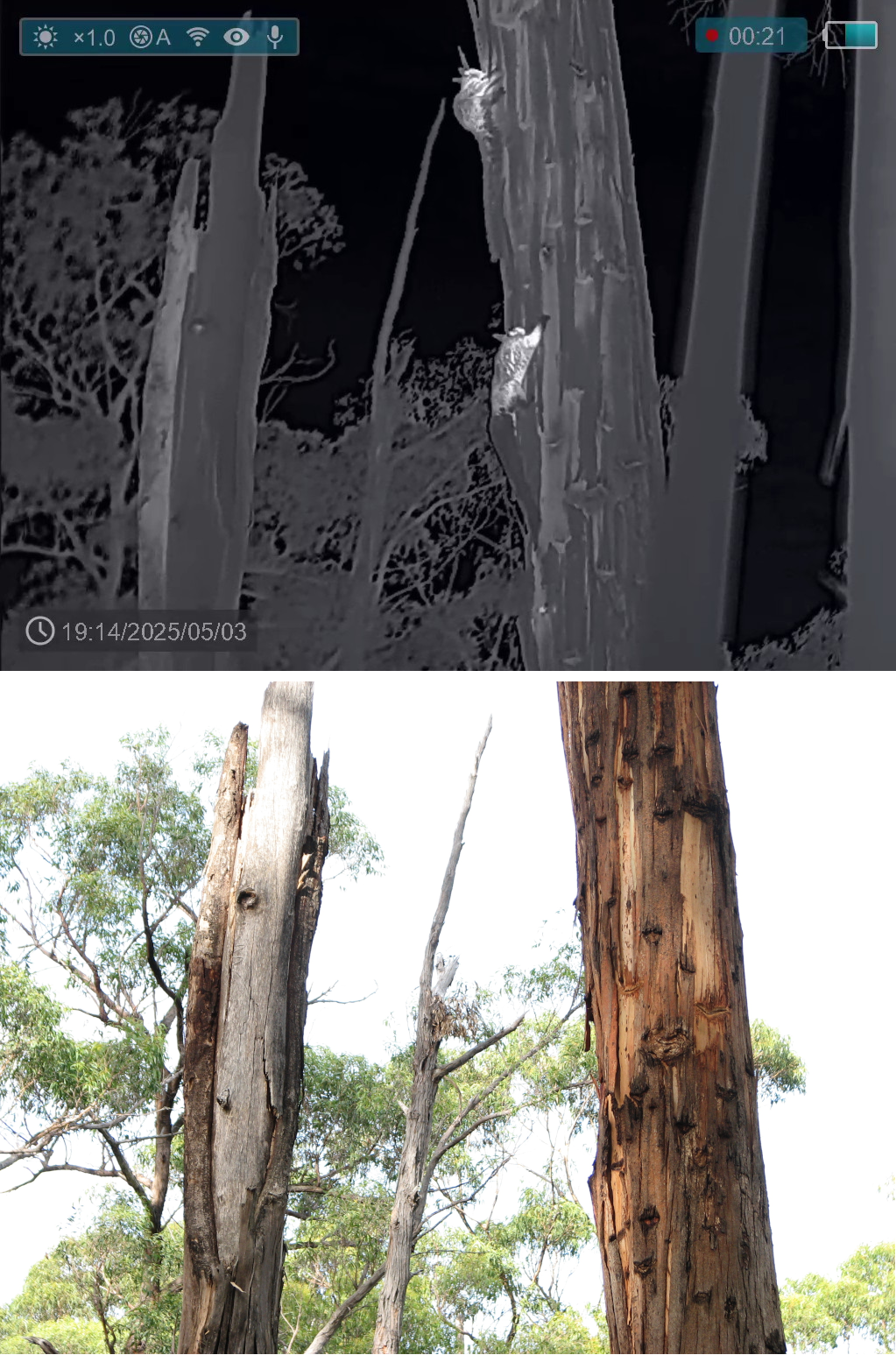
In the first photo below, you can see a thermal image of two Yellow-bellied Gliders feeding on sap of a tree on Sharps Road near Lorne. Just like rubber tappers, they cut a V-shaped incision in the bark and collect the sap as it flows out. The lower photo of the same tree in daylight shows many feeding scars on its trunk. Feed trees, once you know how to spot them, are your first clue to gliders being present. It’s worth the wait to see them at night (no guarantees though). In the link at the end you can watch these gliders feeding on the trunk in video, ending with a long glide to another tree.
Contact us at committee@friendsoflorne.org.au JOIN or renew here.