Newsletter
July 2026
Pt Grey redevelopment in full swing
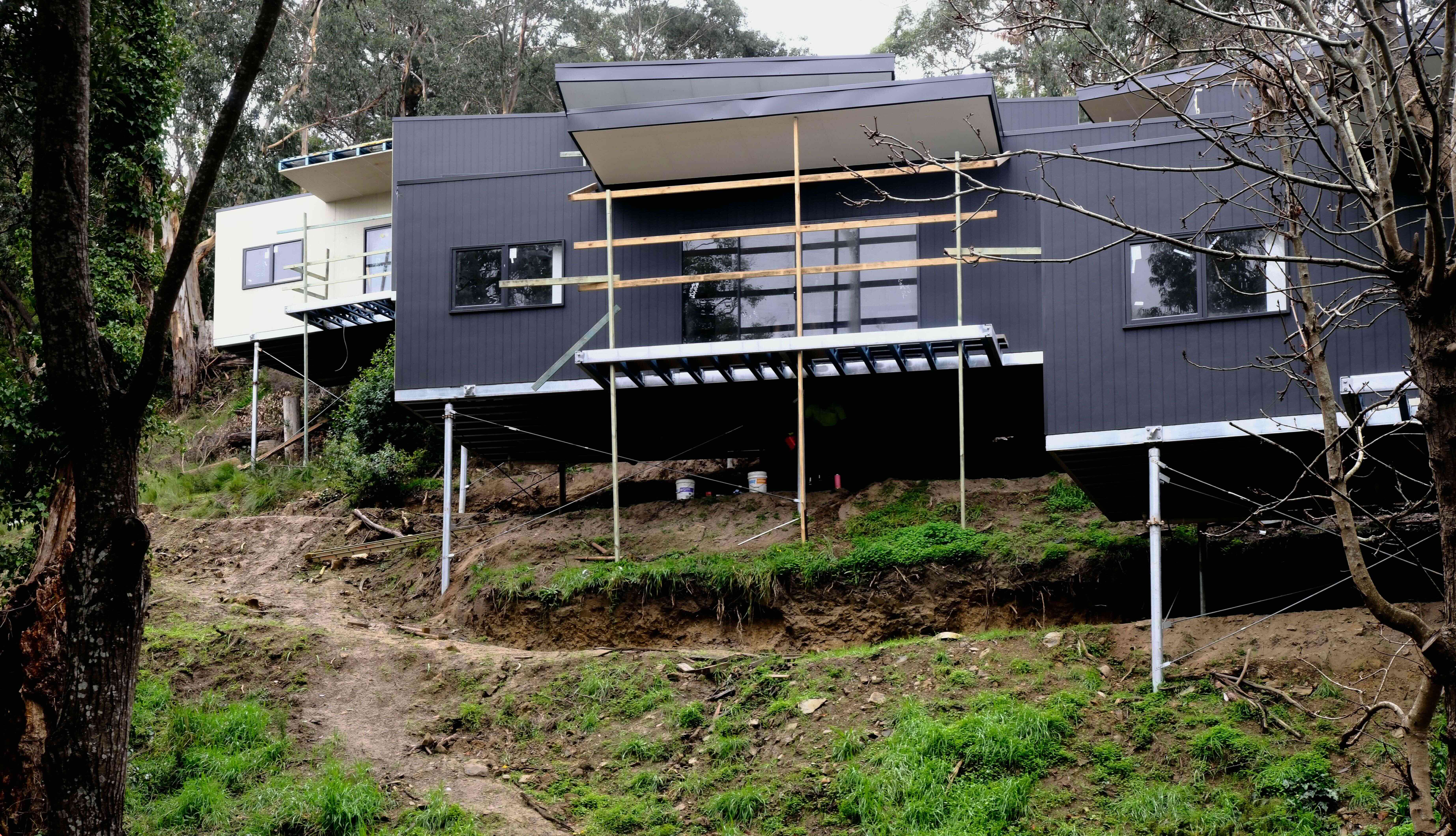
It is a shock to walk around Pt Grey now. GORCAPA gave the Art and History advisory group a hard-hat tour of the building site. Several of the advisory group admitted that it was difficult to look at a clear-felled site. GORCAPA showed us some of the salvaged materials from the co-op building. They explained how the materials will be reused. Some of the original Oregon beams will be remade into furniture for the cafe. We’re told that the Lorne Aquatic and Anglers Club and the new co-op building will be ready by Christmas.
It was confirmed in May that the new co-op building is not as high as the original 1948 structure it is replacing. So, a couta boat hull cannot be suspended in the ceiling under the roof, as we had asked. There is not enough room. A smaller replica or half size boat is being investigated.

News on the crane is not as we originally hoped either.
There was majority support on the Art and History group for bringing the crane back in the form a 2-D drawing on the ground. As an alternative, Friends of Lorne and the Lorne Sculpture Biennale group spoke in favour of a professional assessment of the old crane pieces with the view to some kind of partly original or completely new 3-D sculptural representation. GORCAPA now says that if we want anything more than a 2-D drawing of the crane on the ground the Lorne community will have to pay for it, outside of the Geelong City Deal $12m. They will consider it, if it meets safety and structural standards.
First Nations
With the impending removal of a building from atop a culturally significant site, the project has provided the Eastern Maar the opportunity to create a concept plan to present the Gunditj Lorne Poem in a visual form. Written by Yangamatta John Clarke, the poem was recognised as the Christos Poetry Prize winner in 2020/21. The poem can be seen hanging at the Lorne Bowls club.
Here is a video of John reading the poem at the Christos Poetry prize ceremony.
https://www.facebook.com/share/v/1LdFt9JHHA/
The Gunditj Lorne Garden will provide everyone, local or visitor, a chance to sit and reflect on Gadubanud Country, the landscape and our community.
The garden is also not funded as part of the City Deal project. So Eastern Maar Aboriginal Corporation is currently seeking funding partners to help realise the Gunditj Lorne Garden project, which has the potential to be a key piece of public art that connects the whole Lorne community.
—————-
Would a grant make you rent your Lorne property?
The Surf Coast Shire has the second highest number of properties listed on AirBnB in Australia in terms of percentage. Only Byron Bay beats us.
AirBnB (or similar) is a popular way to manage a holiday property. There’s a booking system and a professional manager. The place looks its best. When you’re not there, the property makes money.
But the overall attractiveness of short-term rental could limit the availability of long-term rental properties. Long term rentals are needed for the Lorne workforce – the school, the hospital, the businesses, and the emergency services.
Local and state authorities across the world have therefore started “interfering” in the market (the term economists love to use). In parts of New York City short-term rental is banned. In Amsterdam there is a 30-day cap. In Australia, Brisbane City, the Sunshine Coast and Margaret River short-term rental owners pay higher rates. In Byron Bay there is a 60-night cap.
Rather than sticks, can policy makers use carrots?
In Lorne there are 465 “whole house” properties listed on AirBnB. The chance of many coming across to the long-term market is slim. But if we could get just 20 of the short-term properties onto the long-term market for 2-3 years (ie, 5%) it could make a huge difference to keeping our local essential workers.
The Surf Coast Shire Council is talking up a long-term rental incentive idea to the state government. In an election year, they are talking to all parties. The Council are proposing a $10k grant in total for 20 participants if they put their property on the long-term rental market for two years. There may be scope for a further funding for an extra year. We started out suggesting a land tax exemption trial. But the SCSC found that a grants scheme was getting more traction in their conversations with state government.
The pilot would be extensively evaluated looking, for example, at the size of the incentive. Is it sufficient? The impact on workers and sectors eg, does it secure the diversity of essential workers we need? How would the shift in occupancy affect the local economy? To monitor the economy, the Council regularly purchases data on credit card spending in Lorne, allowing them to look at the post codes of the credit card owners and thereby track the proportion of spending in Lorne by non-residents versus locals.
Friends of Lorne, among others in the community, have been invited to help shape the details of the trial and its evaluation. So, if you are interested to contribute, please let us know. The ideas and expertise of several of our members have already got us this far, thank you.
Oh and yes, there are eight new 2-bedroom units being built up the back behind the supermarket with the help of a Regional Worker Accommodation Grant from the government. These have been pre-committed to hospitality workers at the Lorne Hotel. The grant conditions only require the units to be available to workers for 5 years.
A big thank you to our members helping the SCSC to design this work.
AVIAN INFLUENZA
What should you do if you see a sick or dead bird?
Avoid contact. Do not allow pets or children near.
Record what you see, the location the bird was found, take photos or videos without approaching or getting close.
Report any unusual illness or deaths in wild birds and other wildlife immediately to the Emergency Animal Disease Hotline on 1800 675 88
Can the beach be roped off to protect a hoodie nest?
Last month “Catherine from Lorne” phoned into ABC 774 to the law program to ask if it was legal to rope off part of the beach to protect hooded plovers. David Whiting’s reply was only if it has been done by an authorised government organisation. Authorised organisations under the Crown Land Reserves regulation 2009 10(1) d for the purpose of Wildlife Protection include GORCAPA and DEECA (Dept of Environment, Energy and Climate Action).
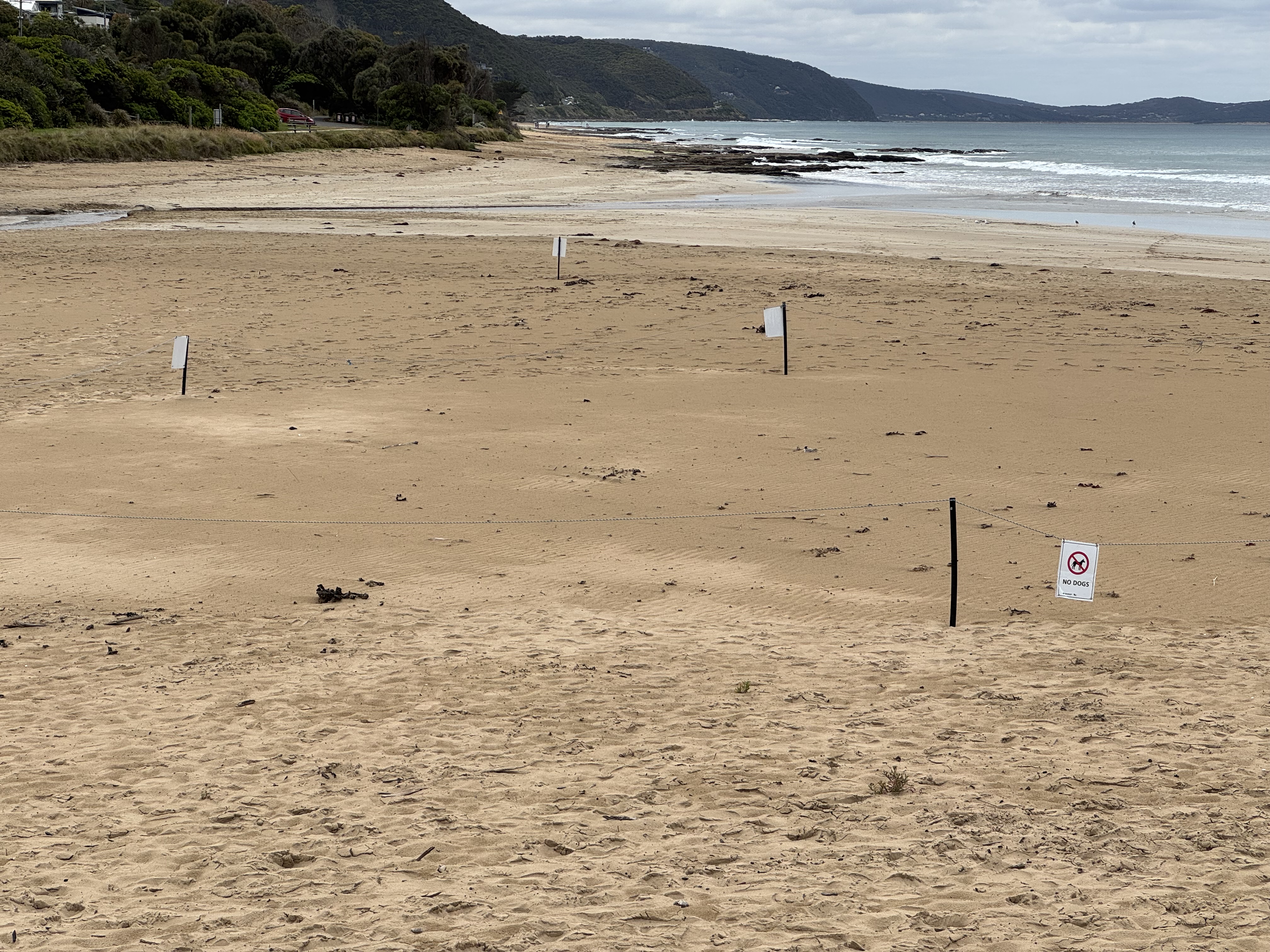
The cheery volunteers you might see (floppy hats and lanyards) are registered with Birdlife Australia to educate, guide, engage and inform the public about the nest, and its importance. However, they cannot stop a person walking through. They can explain that there is a law. They can’t enforce it.
But they can report people they see committing an offence. The Conservation Regulators (part of DEECA) swoop down every now and then and issue fines to people inside the roped- off zone. As does the Council staff if you bring a dog into an area where dogs are not permitted for the purposes of wildlife protection. Our local police have issued fines to people not observing the zone as well. They attend promptly.
So, it was a worthwhile question.
While we are talking hoodies, you might recall that the Lorne nest at the mouth of the Erskine River last season failed. There were no embryos in the eggs. Before that, their nest was further up the beach (in the front of the Mantra). Those eggs were taken by a dog.
But elsewhere along the coast there was slightly better hoodie success last season (September- April). From Torquay to Lorne, there were 19 nests in total. Some nests failed before chicks were hatched and the parents tried again (like in Lorne). Eleven chicks were hatched along the stretch of coast and six survived to fledge (fly away). The successful fledgings were at Aireys, Pt Addis, and Pt Roadknight. Some of our Lorne volunteers helped out on those beaches. Thank you.
Losing our character?
We were getting a bit worried. Lorne seems to be edging away from the treed and modest built environment created and safe guarded by our Neighbourhood Character Overlay (Schedule 2) (NCO). Local Otway councillor and Mayor Libby Stapleton arranged for us to meet with Surf Coast Shire Council planning staff. We learned that there are only about two or three councils in all of the Victoria (the Surf Coast being one) that have a NCO to preserve the special features of the local environment. But that is under threat. The state government wishes to homogenise the planning regulations across the state.
Meanwhile, the planning staff have conducted an audit of past planning applications in Lorne to document the extent to which approvals are in line with certain criteria. Proposed new houses or renovations might, say, be taller than the regulated height, in exchange for being further set back. How often is that occurring? What has been the trend over time with block percentage coverage, the set back, and the colours? Are those still all in keeping with the overlay? Or has there been slippage?
The planners are putting together a report on their audit. We will keep you in the loop, especially if opportunity opens up to review how further planning regulation may affect Lorne. Advocacy to keep Lorne treed and protected from over-development is core business for Friends of Lorne. We reason that we should be able to manage any needed density increases without loss of neighbourhood character.
Celebration and AGM Saturday 17th October
Mark your diaries Friends of Lorne. This year is our 60th birthday. We will host an AGM with an emphasis on the wine, cheese and mingling! Find out more about our early days in the article on our website by Jane Orr, the granddaughter of Beverley Orr, one of our past presidents. You might have read the recent interview with 103-year old Doug Stirling in the Surf Coast Times on the occasion of his Surf Coast Shire Local Legend Award. Doug spoke of his own days of advocacy with the Lorne Planning and Preservation League, as we were once called. We will be out at Qdos from 4-6pm. Plan ahead and join us.
NATURE NOTES Gang-gang Cockatoo Callocephalon fimbriatum
Eva Janice Youl
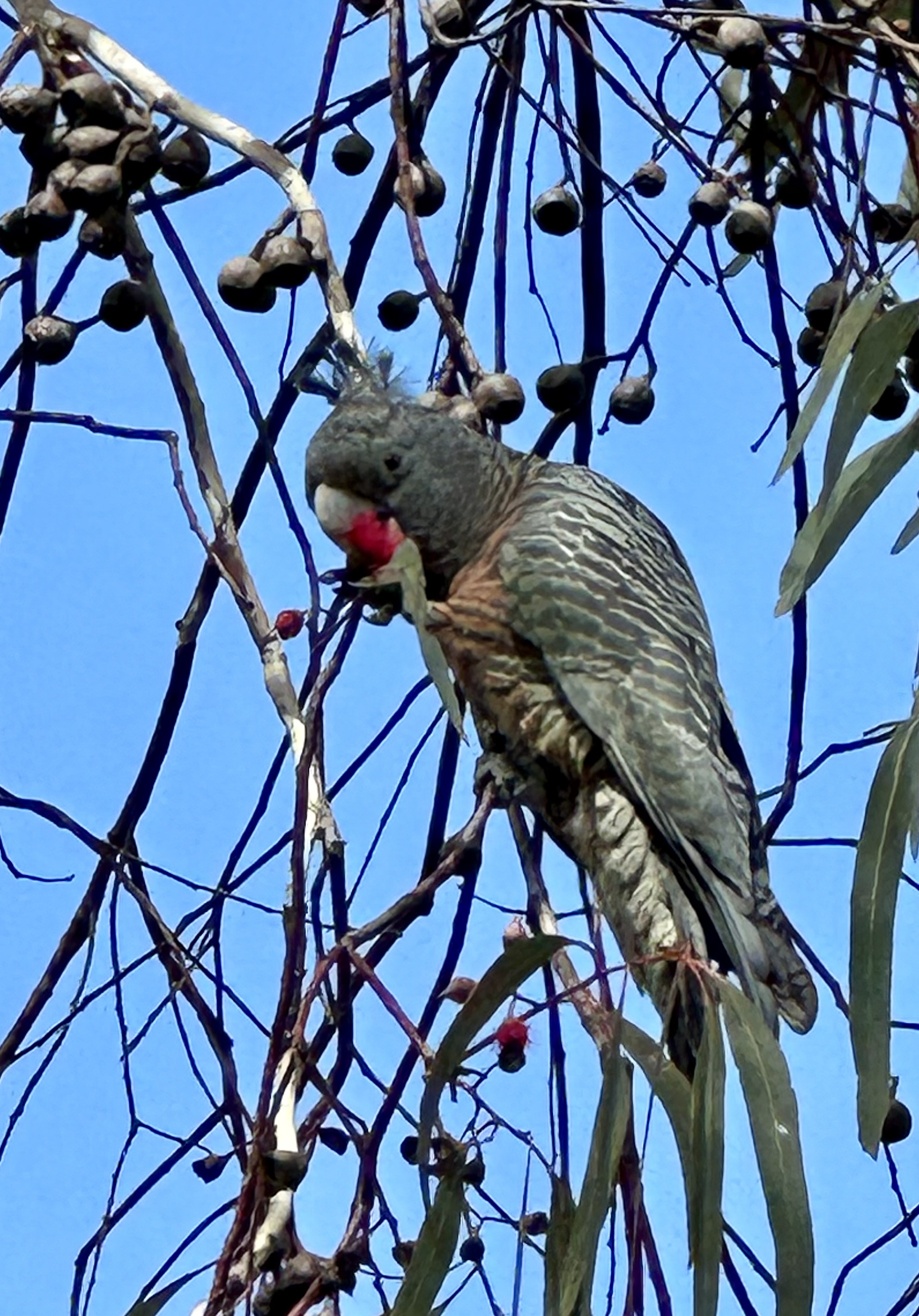
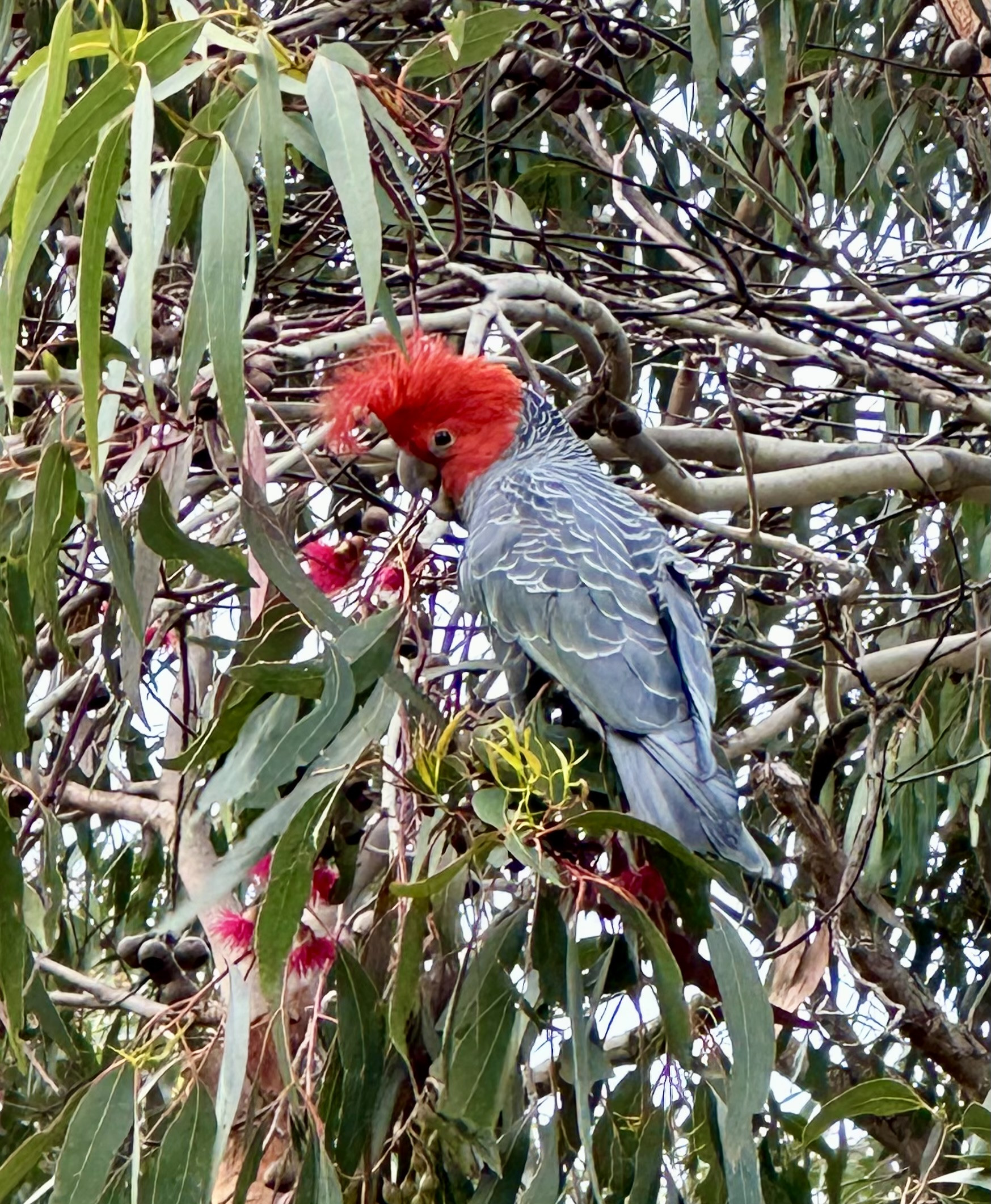
In Lorne we often hear the creaky door sound of Gang-gang Cockatoos as they fly back to their nesting site. I don’t know where. On a May weekend we saw a male and a female in our front yard and I was pleased to see them shrug off a wattlebird who was actively defending his territory with rapid bombing dives. The Gang- gangs growled but were unperturbed.
This couple, the female is well camouflaged, were feasting on our flowering gum which is not indigenous to this area. Corymbia ficifolia is a Western Australian species. At least it was good tucker.
Appearance
The male and female are quite different. The female is a greeny grey colour while the adult male has a bright red helmet and fluffy crest. They are smaller and more stocky than a sulphur crested cockatoo. They have broad wings (62-76 cm wingspan) and a short tail.
Breeding
Gang-gangs don’t start breeding until four years of age. The breeding season is October to January. The perfect home is a hollow in a tall tree lined with decayed debris. The monogamous pair often return to the same nesting tree each year. Both the male and female prepare the nest and both incubate the up to three white rounded eggs. After fledging it is thought that several pairs aggregate the young in ‘creches’.
Feeding
The main diet is seeds with a preference for eucalypts and wattles. They also berries, fruits, nuts and insects. Like most cockatoos, they usually use their left foot to hold food when eating.
Call
The Gang-gang has a distinctive creaky door screech. The sound is quite loud when a flock flies over. As mentioned previously, I was particularly amused when a territorial wattle bird dived down on the male gang-gang like a Kamikaze pilot. The gang-gang didn’t budge but gave out a growl.
Current Status
Gang-gangs are considered rare and are officially listed as an endangered species in Australia. Their populations declined by approximately 70% between 1999 and 2019, a situation worsened by the 2019-2020 bushfires, leaving an estimated 25,300 mature birds remaining in the wild.
Here is the Australian Government Conservation Advice for Gang-gangs which explicitly says that the primary reason this species is considered endangered is for its population decline by 69% (over 20 years – 1999-2019).
Conservation Advice for Callocephalon fimbriatum (Gang-gang Cockatoo)
As the above Government site states, habitat is critical to the survival of the Gang-gang cockatoo. It is important to maintain both summer and winter habitats for both breeding and foraging. Like other parrots, owls and kookaburras, many native birds need old trees with hollows. This is why clearing forests of dead trees or dead branches is detrimental. There are some introduce species that aggressively compete for these hollows.
On the web I noticed you can buy a gang-gang which is legal if it is a captive-bred bird. Taking them from the wild is strictly illegal, but I must say I was surprised about caged birds and different states have different licence requirements.
Citizen Science
I tried to find out what data there is for gang-gang cockatoos, I started with BirdLife Australia. This Gang-gang Cockatoo is the fauna emblem of the ACT and yes there is a citizen science project in Canberra to count the declining numbers. The Canberra Ornithologists Group is involved.
I know BirdLife Australia has a project for the Red-tailed Black Cockatoo west of Lorne because a friend participated in the recent annual count. However I couldn’t find anything on Gang-gangs.
In the past I have been involved in data collection for both iNaturalist and also the Atlas of Living Australia. This last project in the wilderness, in conjunction with The University of Melbourne and selected Year 11 students was quite memorable, mostly because it poured rain at our camp site on the Snowy River! But seriously, the Atlas of Living Australia holds comprehensive and accessible information for decision making and collaboration. Check out web link biocollect.ala.org.au and perhaps Friends of Lorne could make a contribution.
All articles are by the Committee of Friends of Lorne unless otherwise specified.